Article · 04 March 2026
1991: The Year India Nearly Went Broke
20 days of foreign reserves. 67 tonnes of gold airlifted abroad.
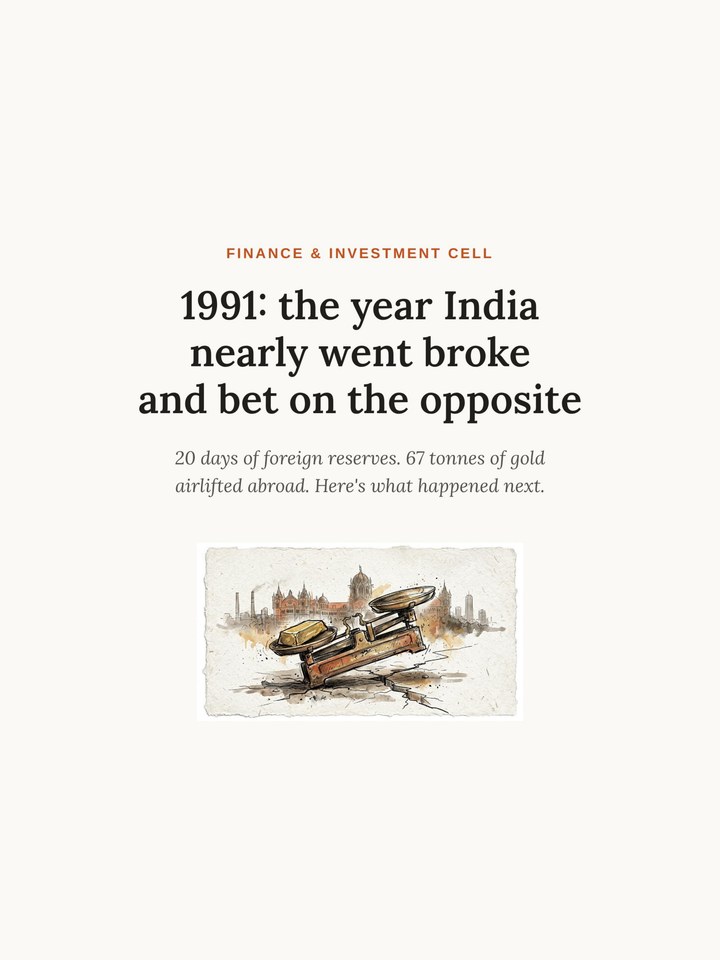
Sometime in June 1991, the Reserve Bank of India was staring at a genuinely terrifying number. A country of nearly 850 million people had enough foreign currency on hand to pay for a few weeks of imports, nothing more.
Oil bills, machinery parts, anything bought from abroad — all of it suddenly at risk of going unpaid.
It didn't happen overnight. The fiscal deficit crept up through the 1980s, government debt ballooned, and then the Gulf War hit oil prices right as remittances from the Gulf dried up and NRIs began pulling deposits out.
Less a single event, more a decade of imbalances finally catching up.
| Indicator | Mid-1980s | 1990–91 |
|---|---|---|
| Fiscal deficit (% of GDP) | 9% | 12.7% |
| Government debt (% of GDP) | 35% | 53% |
| Current account deficit (% of GDP) | 2.3% | 3.1% |
The government airlifted roughly 67 tonnes of gold to the Bank of England and the Union Bank of Switzerland as collateral, just to raise enough dollars to keep the country solvent.
India was weeks away from defaulting on its external debt for the first time since independence, before the IMF stepped in with an emergency loan.
A budget most economists thought was politically impossible.
| # | What changed |
|---|---|
| 01 | Import licensing gutted |
| 02 | The rupee devalued |
| 03 | Tariffs cut from over 300% on some goods |
| 04 | Banking, telecom and aviation opened to private and foreign players |
Every metric that mattered in 1991 looks unrecognisable today. This isn't growth, it's a different country's balance sheet entirely.
| Metric | 1991 | 2026 |
|---|---|---|
| Forex reserves | $1B | $700B+ |
| Annual FDI | <$0.1B | ~$80B |
| Trade (% of GDP) | ~16% | ~48% |
| GDP per capita | $303 | $2,700 |
| Rupee / US dollar | ₹19.2 | ₹95.4 |
The Sensex sat under 1,000 in early 1991. Today it prints above 78,700.
It wasn't a clean story of everyone winning together. Manufacturing jobs disappeared while services and tech absorbed the gains, unevenly, and mostly in urban India.
Rural India, informal labour, and large parts of the eastern states haven't seen the same trajectory as Bangalore's IT corridor or Gurugram's finance sector.
The buffers today are real, and the economy is structurally different. That doesn't mean complacency is warranted — current account dynamics and global rate cycles can still bite — but the starting point is nowhere close to where it was in June 1991.
The full ten-page piece with all charts and illustrations.