Case Study · 06 February 2026
Stock Market Volatility & Crash Trends
2025–2026, set against the crashes that came before it.
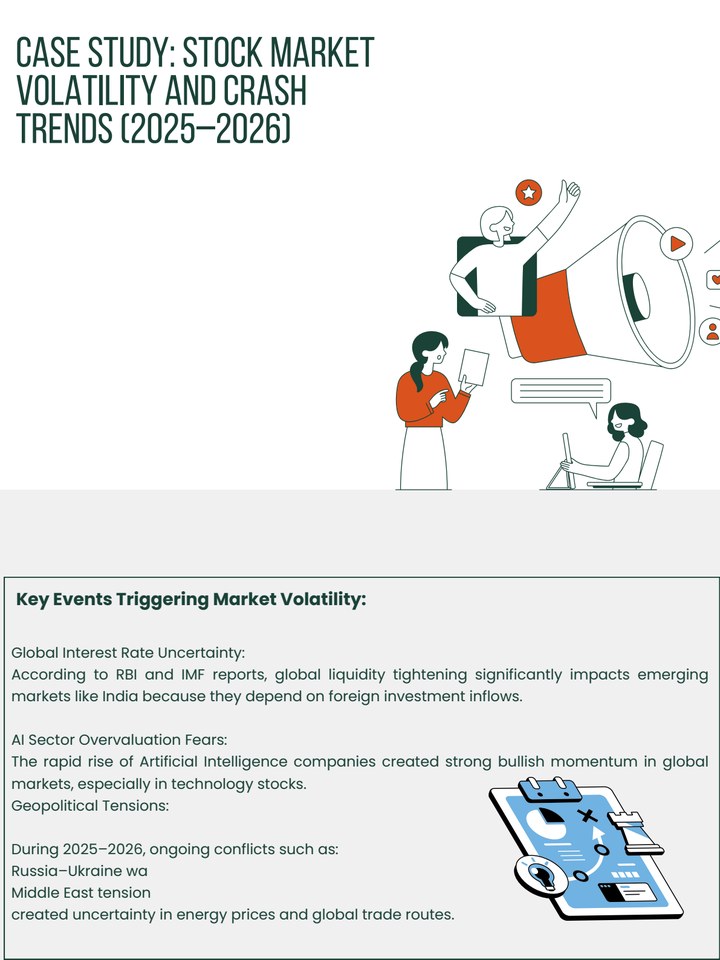
According to RBI and IMF reports, global liquidity tightening significantly impacts emerging markets like India, because they depend on foreign investment inflows.
The rapid rise of artificial intelligence companies created strong bullish momentum in global markets, especially in technology stocks.
Through 2025–2026, ongoing conflicts — the Russia–Ukraine war and Middle East tensions — created uncertainty in energy prices and global trade routes.
During volatility phases, the Nifty experienced sharp short-term corrections. IT and technology sectors showed significant fluctuations, while PSU banks and infrastructure stocks showed relatively stable growth.
| Sector | Behaviour |
|---|---|
| IT | Highly volatile due to global dependency |
| Banking | PSU banks showed strong recovery |
| FMCG | Defensive sector, relatively stable |
| Energy | Impacted by crude oil price fluctuations |
| Crash | Cause | Similarity with 2025–26 |
|---|---|---|
| Dot-Com Bubble (2000) | Tech overvaluation | AI stock overvaluation fears |
| Global Financial Crisis (2008) | Banking collapse | Liquidity concerns |
| COVID Crash (2020) | Economic shutdown | Global uncertainty and panic |
The 2025–26 volatility differs because economic fundamentals remained relatively stable compared to earlier crises.
Investors should diversify across equity, bonds, gold and mutual funds.
Historical data shows markets recover over time. Investors who stay invested usually benefit from compounding returns.
Panic selling often results in losses. Base decisions on research rather than market rumours.
Systematic Investment Plans matter here too — SIPs help investors average purchase costs during volatile markets and reduce timing risk.
The stock market volatility during 2025–2026 highlights how interconnected global financial systems have become. Even strong domestic economies like India are influenced by international monetary policies, technological trends, and geopolitical developments.
The full three-page case study.