Periodical · FinNFacts · January 2026
FinNFacts — January Wrap
The Economic Survey, the state of the economy, and the reserve increment.
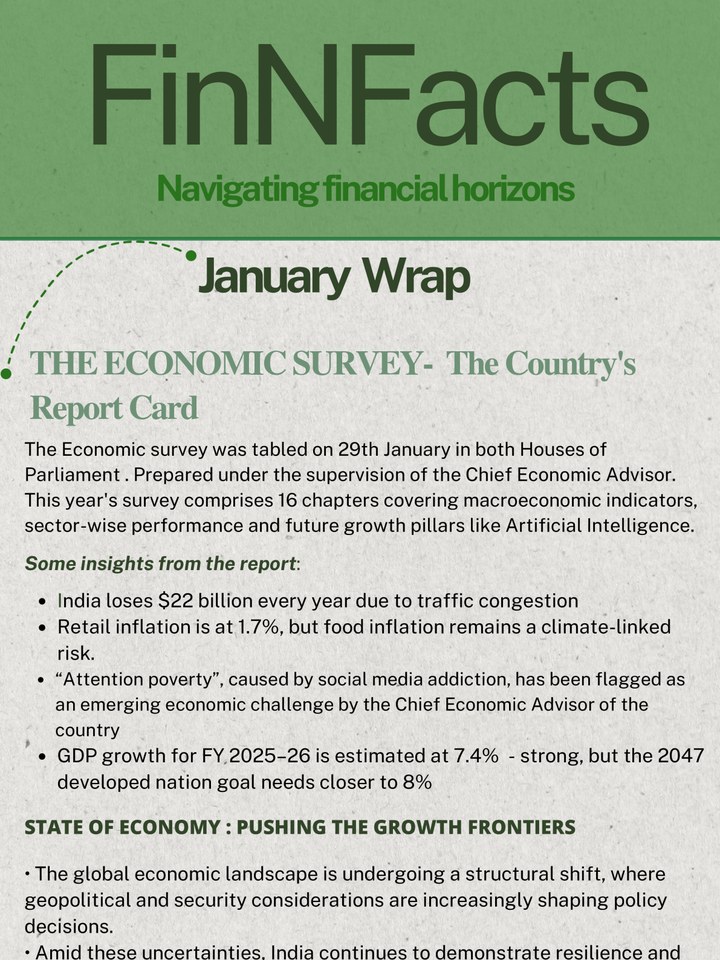
The Economic Survey was tabled on 29th January in both Houses of Parliament, prepared under the supervision of the Chief Economic Advisor. This year’s survey comprises 16 chapters covering macroeconomic indicators, sector-wise performance and future growth pillars like artificial intelligence.
| Finding | Detail |
|---|---|
| Traffic congestion | India loses $22 billion every year |
| Retail inflation | 1.7%, but food inflation remains a climate-linked risk |
| “Attention poverty” | Caused by social media addiction, flagged as an emerging economic challenge by the CEA |
| GDP growth FY 2025–26 | Estimated at 7.4% — strong, but the 2047 developed-nation goal needs closer to 8% |
The global economic landscape is undergoing a structural shift, where geopolitical and security considerations are increasingly shaping policy decisions. Amid these uncertainties, India continues to demonstrate resilience and growth momentum.
India enters FY26 with strong economic momentum supported by stable macroeconomic fundamentals, sustained policy support, and broad-based sectoral performance. Despite a challenging global environment, the economy has remained resilient, with robust growth, historically low inflation, improving labour market indicators, and strengthening external and financial buffers.
| Measure | Reading |
|---|---|
| Real GDP growth, FY27 | Projected in the range of 6.8–7.2% |
| Sectoral contribution | Agriculture stabilising rural demand, manufacturing gaining momentum, services leading expansion |
| Total exports | USD 825.3 billion in FY25 and USD 418.5 billion in FY26 |
| Repo rate | 5.25% as of December 2025 |
India's foreign exchange reserves rose sharply, reflecting strong capital inflows and favourable valuation effects. The surge follows a strong two-week rally, with reserves increasing by USD 14.17 billion, followed by a further USD 8.05 billion rise.
Foreign Currency Assets, the largest component, grew on valuation gains from non-dollar assets and renewed foreign investment inflows. Gold reserves increased as the RBI diversified holdings and reduced currency risk. Reserves now cover 94% of India’s external debt, significantly strengthening external stability.
The full three-page January edition.