Case Study · 23 December 2025
Jane Street: From Trading Giant to SEBI's Ban
A case study on index manipulation, regulation, and market integrity.
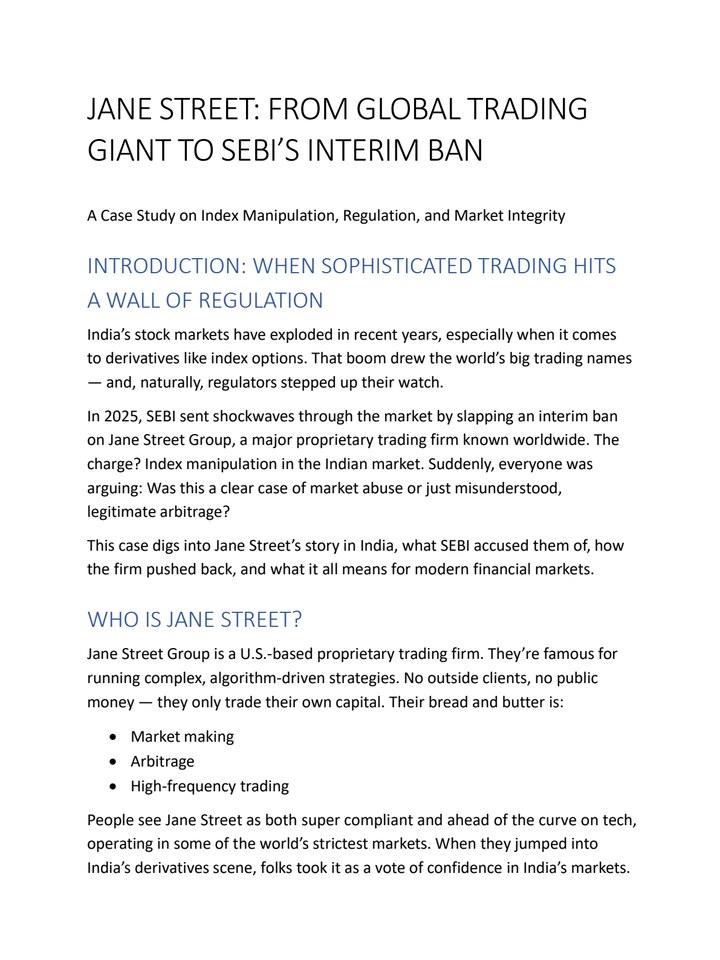
India's stock markets have exploded in recent years, especially when it comes to derivatives like index options. That boom drew the world's big trading names — and, naturally, regulators stepped up their watch.
In 2025, SEBI sent shockwaves through the market by slapping an interim ban on Jane Street Group, a major proprietary trading firm known worldwide. The charge? Index manipulation in the Indian market. Suddenly, everyone was arguing: was this a clear case of market abuse, or just misunderstood, legitimate arbitrage?
Jane Street Group is a U.S.-based proprietary trading firm famous for running complex, algorithm-driven strategies. No outside clients, no public money — they only trade their own capital. Their bread and butter is market making, arbitrage and high-frequency trading.
People see Jane Street as both highly compliant and ahead of the curve on tech, operating in some of the world's strictest markets. When they jumped into India's derivatives scene, folks took it as a vote of confidence in India's markets.
India's derivatives market, especially Nifty and Bank Nifty options, is now one of the world's busiest — huge volumes on expiry days, a lot of retail traders in the mix, and settlement prices that hinge on where the index closes. That setup makes expiry day extremely sensitive.
SEBI's surveillance flagged something odd: big bets on certain index outcomes in the derivatives market, heavy trading in some index stocks, and sudden price jumps right before the close on expiry days. Put together, these raised a question — was someone moving the index, not just reacting to it?
| SEBI action | Detail |
|---|---|
| Ban | Jane Street barred from trading in Indian markets |
| Escrow | Alleged profits taken and locked away |
| Status | Explicitly not a final verdict — a preventive measure |
SEBI pointed to the SEBI Act, 1992 and the FUTP (Fraudulent and Unfair Trade Practices) Regulations. The kicker: under these rules, regulators don’t always have to prove intent. If your trades mess with fair price discovery, that’s enough.
SEBI argued Jane Street built huge derivative positions, traded big in certain index stocks at the same time, and moved index closing prices during key settlement windows — creating a false sense of trading activity and putting retail investors at risk.
Jane Street flatly denied any foul play: everything they did was rational arbitrage, trading both cash and derivatives is the job, and big trades don’t equal manipulation. They also called out SEBI for not giving them a fair hearing first, and took the fight to the Securities Appellate Tribunal.
| Arbitrage | Manipulation |
|---|---|
| Makes markets more efficient | Pushes prices away from fair value |
| Corrects price differences | Creates fake signals |
| Responds to what’s happening | Makes things look different from what they are |
In today's lightning-fast, algorithm-packed markets, telling the difference isn't easy. Speed and scale can make normal trading look suspicious.
After the order, proprietary and algorithmic traders got a lot more cautious, people rethought their expiry-day strategies, and the debate over high-frequency trading got far louder. For foreign investors the message was mixed: India takes market fairness seriously, but regulatory risk is always lurking.
| # | Lesson |
|---|---|
| 01 | Technology moves faster than the rule book. Markets keep evolving, and the law is always playing catch-up. |
| 02 | Outcomes matter more than motives. Modern regulators look at the impact of trades, not just intent. |
| 03 | Compliance is local. A clean record globally doesn’t mean you’re in the clear everywhere. |
| 04 | Retail investors come first. SEBI puts fairness and protecting small investors above all else. |
The full four-page case study.