Article · 17 July 2026
India's Inflation Just Broke Its Ceiling
Nobody quite agrees on what happens next.
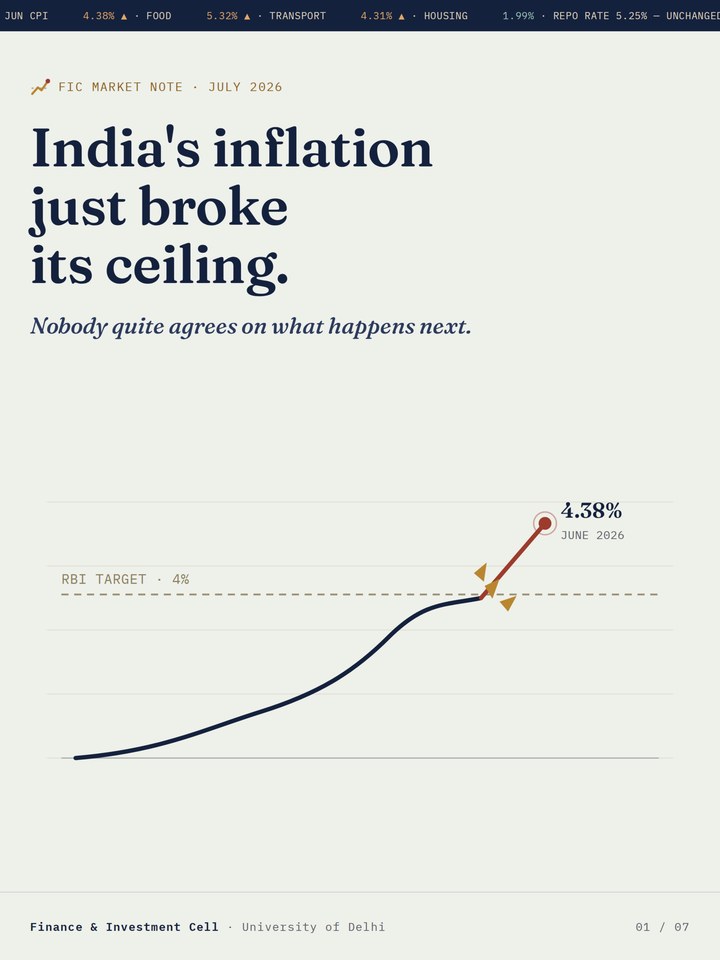
India's retail inflation for June 2026 — the first breach of the RBI's 4% target in seventeen months.
This wasn't a sudden spike. It was the third straight month inflation crept upward, slowly, almost politely, until it finally tipped over the line everyone had been watching. From January's 2.75% to June's 4.38%, the climb has been steady rather than dramatic, which is arguably the more interesting story here.
Food did the heavy lifting, climbing to 5.32% on the back of a handful of volatile items rather than a broad rise. Transport rebounded too, as the delayed pass-through of the Middle East oil shock finally reached Indian pumps. Housing, meanwhile, barely moved. This is a narrow story, not an everything-is-expensive one.
The June print landed above forecast, and yet the desks reading it are split into three genuinely different camps, not just optimists and pessimists.
No hike in 2026 unless core inflation sustains above 4.5%, seen as unlikely.
Cut its FY27 inflation forecast by 40 bps to 4.6%.
Expects July inflation near 4.6%, but still sees the RBI holding steady at the August meeting anyway.
Reversed its earlier call for an August hike entirely.
Sees inflation nearing 5% by August–September, with a hike possible as early as the August MPC meeting.
Worth remembering the RBI wasn't caught off guard here. Back in June, before this print even landed, the central bank had already cut its growth outlook and raised its inflation forecast, all while holding the repo rate steady. That's a central bank quietly bracing for a messier year.
Markets, for what it’s worth, are leaning toward the calmer read. One-year interest rate swaps have repriced sharply since the June policy meeting — from pricing 125 bps of tightening before the meeting, down to 50 bps after the June CPI print.
Honestly, the August MPC meeting is probably the more telling data point here, not June's number itself. The Monetary Policy Committee meets 03–05 August 2026.
The RBI treats June as a temporary, weather- and oil-driven blip. Expect a hold, and cautious language about the “durability of disinflation.”
A weak monsoon keeps vegetable prices elevated through July. The hawkish camp starts looking a lot more credible.
Either way, it's a good reminder that inflation prints rarely tell the whole story alone. It's the composition underneath — food versus fuel versus core — that tells you whether you're looking at noise or a genuine shift.
The full seven-page note, formatted as published — charts, ticker rails and all.