Periodical · FinNFacts · October 2025
FinNFacts — October Wrap
GFF 2025, the digital engine, and GST 2.0.
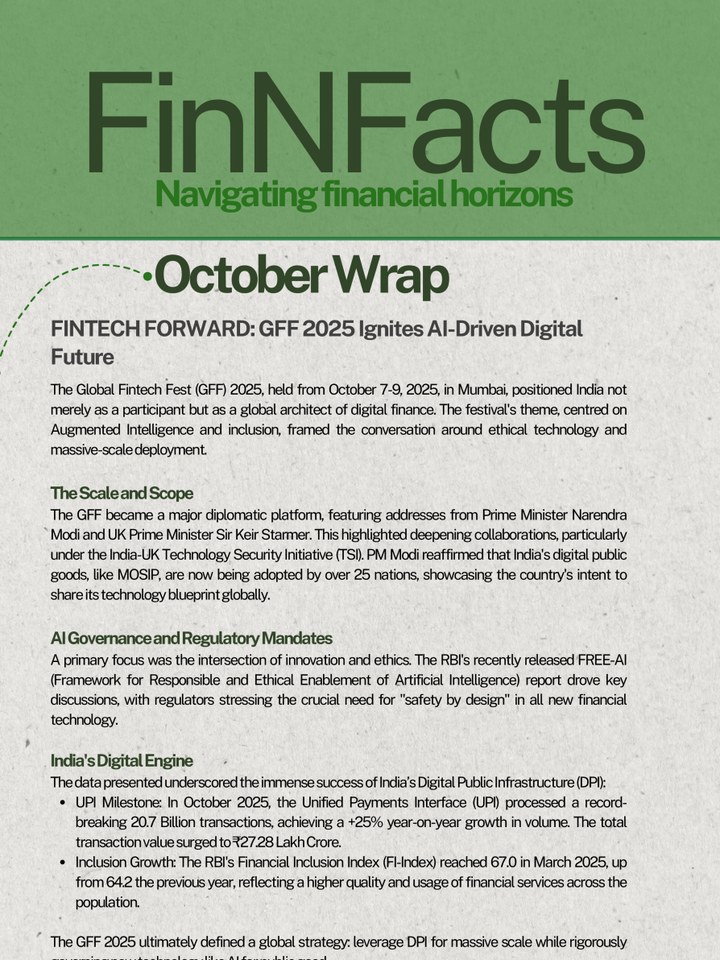
The Global Fintech Fest 2025, held from October 7–9 in Mumbai, positioned India not merely as a participant but as a global architect of digital finance. The festival’s theme, centred on augmented intelligence and inclusion, framed the conversation around ethical technology and massive-scale deployment.
GFF became a major diplomatic platform, featuring addresses from Prime Minister Narendra Modi and UK Prime Minister Sir Keir Starmer. This highlighted deepening collaborations, particularly under the India–UK Technology Security Initiative. PM Modi reaffirmed that India’s digital public goods, like MOSIP, are now being adopted by over 25 nations.
A primary focus was the intersection of innovation and ethics. The RBI’s recently released FREE-AI (Framework for Responsible and Ethical Enablement of Artificial Intelligence) report drove key discussions, with regulators stressing the crucial need for safety by design in all new financial technology.
The data presented underscored the immense success of India’s Digital Public Infrastructure. The RBI’s Financial Inclusion Index reached 67.0 in March 2025, up from 64.2 the previous year, reflecting a higher quality and usage of financial services across the population.
With the GST rationalisation taking effect at the end of September, October marks the first full month where its real impact has started to show across industries, consumers, and compliance systems. The reform, one of India’s biggest tax overhauls since 2017, is now actively influencing price trends, input costs, and business operations.
As of 22 September 2025, the GST rate structure was rationalised. The earlier four major slabs — 5%, 12%, 18% and 28% — were largely replaced by two main slabs, 5% and 18%, plus a 40% slab for luxury and sin goods. Many goods previously taxed at 12% have been shifted to 5%, and goods in the 28% bracket mostly moved to 18%, or for luxury and sin items, to 40%. Certain goods and services have been exempted entirely, notably individual health and life insurance.
The earlier system had long-standing structural issues: frequent inverted duty structures, a high compliance burden for MSMEs, technological and filing complexities, and slow dispute resolution due to non-functional tribunals.
| Category | Effect |
|---|---|
| Groceries | UHT milk, paneer, roti and khakhra now fall under the exempt category |
| Personal care | Everyday essentials shifted from 18% to 5% |
| Education | Exemption on notebooks, pencils and basic stationery |
| Festive purchases | Lower GST on select processed foods, dairy items and décor essentials |
Key sector movements were visible across agriculture, where reduced GST on irrigation equipment and bio-pesticides improved affordability for farmers; textiles, where correction of inverted duty structures is allowing yarn and garment units to operate with fewer refund delays; packaging, where lower rates on kraft paper, laminates and adhesives are reducing costs for FMCG and logistics companies; and processed foods, where manufacturers report moderate reductions in input costs.
| Term | Meaning |
|---|---|
| Tax slabs | The percentage rates applied to goods and services. Under GST 2.0: 0%, 5%, 18% and 40% |
| Luxury / sin goods | Products considered non-essential or harmful — alcohol, tobacco, luxury cars — taxed at higher rates |
| Rate rationalisation | The process of merging and simplifying multiple tax rates to reduce complexity |
| Inverted duty structure | Where the tax rate on inputs is higher than on outputs, leading to inefficiencies |
| Input Tax Credit (ITC) | A mechanism allowing businesses to claim credit for taxes paid on inputs used to make taxable supplies |
| Dispute resolution | Legal and administrative mechanisms for resolving tax-related disputes |
| E-Way bills | An electronic document required for the transportation of goods in India, specifically for goods valued over ₹50,000 |
The full four-page October edition, including the GST glossary.