Periodical · BULLE-'FIN' · Chanakya Smriti '26
BULLE-'FIN' Annual Edition
RBI's fraud shield, and the tariff regime reshaping global capital.
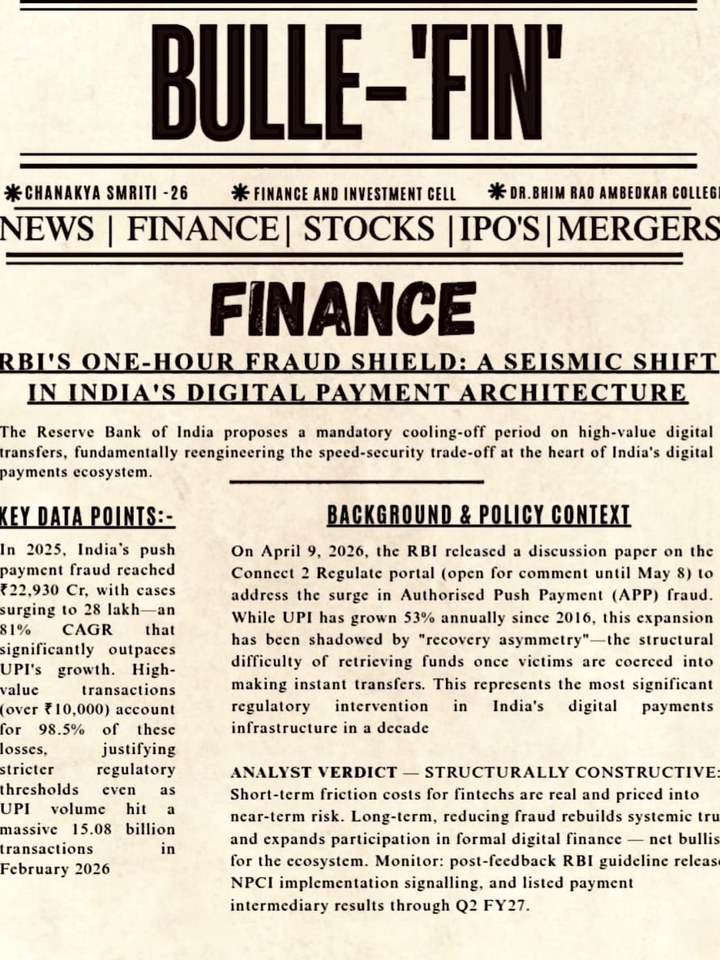
The Reserve Bank of India proposes a mandatory cooling-off period on high-value digital transfers, fundamentally reengineering the speed–security trade-off at the heart of India’s digital payments ecosystem.
High-value transactions, over ₹10,000, account for 98.5% of these losses — justifying stricter regulatory thresholds. On April 9, 2026, the RBI released a discussion paper on the Connect 2 Regulate portal, open for comment until May 8, to address the surge in Authorised Push Payment fraud.
| # | Safeguard |
|---|---|
| 01 | One-hour lagged credit. A 60-minute mandatory window for account-to-account transfers exceeding ₹10,000. The sender’s account is debited immediately, but funds are held for one hour to allow real-time fraud screening and sender cancellation. Exempts merchant payments, recurring EMIs, standing instructions and cheque-based transfers. |
| 02 | Trusted contact verification. Transfers above ₹50,000 initiated by senior citizens aged 70+ or persons with disabilities require confirmation from a pre-designated trusted contact. |
| 03 | Annual credit limits on low-KYC accounts. A ₹25 lakh annual cap targeting mule account networks estimated to channel 30–40% of laundered digital fraud proceeds. |
| 04 | Universal kill switch. Allows any account holder to instantly disable UPI, net banking and debit cards simultaneously, with reactivation requiring re-authentication at a branch or verified digital channel. |
This intervention carries a moderate policy beta of 0.65–0.75, largely because merchant payments remain exempt. By mitigating the ₹22,930 Cr lost annually to fraud, these measures will expand the long-term total addressable market for compliant infrastructure, effectively rebuilding institutional trust in the UPI ecosystem. Banks that integrate these mechanisms seamlessly will gain a regulatory competitive advantage, while tech-dependent fintechs may see FY26 margins pressured by the cost of upgrading real-time architectures.
Mandatory transaction lags conflict with the “instant payment” ethos that fuelled UPI’s adoption, potentially confusing new users in semi-urban and rural areas.
Fraudsters may pivot to high-pressure tactics, coercing victims into whitelisting fraudulent transactions during the mandated review window.
Given these complexities, a phased rollout targeting high-risk corridors is the most probable path following the May 8 deadline.
From a landmark Supreme Court ruling to a $29 billion retail burden, the 2026 US tariff regime is the defining macro event of this investment cycle, forcing a complete recalibration of global equity positioning.
The February 2026 15% universal tariff — the largest hike relative to GDP since 1993 — has quadrupled the 2025 baseline. Despite the Russell 2000 outperforming the Nasdaq by 9 percentage points, 61% of executives report severe margin stress.
April 2025 “Liberation Day” executive actions imposed sweeping reciprocal tariffs on 180+ countries under IEEPA, pushing effective US tariff rates to multi-decade highs — China rates reached 54% broadly and 145% in high-sensitivity sectors. On February 20, 2026, the Supreme Court delivered a 6–3 ruling declaring IEEPA-based tariff authority unconstitutional, briefly buoying markets on expectations of a $180 billion duty refund. Four days later, the administration invoked Section 122 of the Trade Act of 1974 — a rarely used tool permitting 15% tariffs for 150 days in a balance-of-payments emergency — reimposing a universal global tariff and nullifying the relief rally.
The defining market response has been a pronounced shift in equity capital away from multinational large-cap technology and consumer discretionary names toward domestically oriented small caps, energy, and industrial reshoring beneficiaries. Domestic small-caps carry near-zero — effectively negative — tariff beta, an increasingly valuable property. The energy sector emerged as the primary safe-haven trade, with ExxonMobil and Chevron largely exempt from universal tariff provisions while benefiting from a domestic demand surge. Secondary and resale platforms reported record customer growth as consumers traded down from tariff-inflated new merchandise.
The current tariff regime is driving a stagflationary trend, with core PCE seeing a 50 bps uplift that complicates the Fed’s rate-cutting path. While the measures generate $180 billion in annual revenue, they impose a regressive $1,500 tax increase per household, disproportionately hitting lower-income brackets.
The full annual edition, as printed in Chanakya Smriti ’26.